Thursday, 12 October 2017

Critical Investigation: Project proposal

Working title
"To what extent are gender roles in horror remakes like 'Bates Motel' adapted for contemporary audiences?"

Angle

Due to desensitisation and the general impact of time on audiences, horror has changed significantly. As a result, gender roles have also been altered, yet we can still argue huge similarities from how gender in horror was used to how it is currently used now. Gender is exploited to portray women as the weaker sex (feminist stance)

Hypothesis

I believe that gender in horror is used to reinforce the idea that females are the weaker sex.

Linked production piece
Perhaps a graphic print from for a psychology horror found in a contemporary magazine/film brochure and as a 1960's style print for a the same genre. Also, a horror trailer or opening scene.
MIGRAIN

  • Norman Bates is a young man, suffering from dissociative identity disorder, who runs a small off-highway motel in Fairvale, California. As a child, Bates suffered severe emotional abuse at the hands of his mother. When Norma took in a lover, the teenage Norman killed them both with strychnine in a fit of jealousy and forged a suicide note to make it appear that the pair had killed themselves in a suicide pact.
  • Norman Bates is being represented in a somewhat psychotic and multi faced way because it reflects on his personality disorder(s). His dual personality can be explained with the Freudian notion that all humans are bi-sexual and heterosexuality is shaped by our society.
  • Norman's brother, Dylan, acts as a literary foil, demonstrating Norman's insanity with his calmer demeanour. He is much more socially competent in comparison to Norman despite being a child  conceived from incestuous acts forced upon his mother's brother.
  • the representation is fair and accurate. Considering it was based on two original texts, there is a lot of evidence supporting that this is how the characters were meant to be represented. More generally, the character's all symbolise a variety of different notions or ideas fairly and accurately. Although there are stereotypes such as Norma's rapist being a misogynist, fat, white man or how Norman is presented as the stereotypical 'nerd', as he is bullied. These stereotypes are negative as they have a larger implication of viewers; it reinforces stereotypes that are not always true.
  • Denotation is the first level of analysis. What the audience can visually see on a page. Denotation often refers to something literal. In Bates Motel, we see a slightly dysfunctional family trying to make the best of the situation they are in. Connotations of this run much deeper. One example of denotation are simply the character's names.
  • In terms of costume, Norman is seen in typically very smart clothes. This adds to the conflicted view, viewers have of him. Everything about the character of Norman bates contradicts each other. Another type of clothing Norman wears is his mother's clothing. This develops the idea of Norman believing he 'is' her. 
  •  For lighting, often in scenes where suspense is being built, lighting is more low-key. However, usually the lighting is often high-key. Mise-en-scene refers to everything in the scene.
  • The main set is a replica of the original Bates Motel set from the film Psycho was built on location at approximately 1054 272nd Street in Aldergrove, British Columbia. 
  • For props, Norman likes to keep mementos of his victims such as his teachers necklace. Also, he is interested in taxidermy, adding to his already neurotic demeanour. 
  • In terms of setting, the main set is a replica of the original Bates Motel set from the film Psycho was built on location at approximately 1054 272nd Street in Aldergrove, British Columbia. This really connects the series to it's roots.
SHEP

Social-

  • The hippie movement began in San Francisco, California, in the early 1960s and progressed into the late 1970s.
  • more fluidity in censorship; restrictions were less frigid
  • Psycho challenged many restrictions e.g showing lingerie or toilets.
Historical-
  • The first media text of Psycho was released in 1959
  • The first moving media text of Psycho was released in 1960
  • The character was inspired by Wisconsin murderer Ed Gein
  •  During the 1960's, a range of cultural freedoms were sparked that helped in the production of this film including freedom to explore one’s potential, freedom to create one’s Self, and freedom of personal expression.
  • There were huge changes in censorship in this time period also
Economic-
  • $103 million domestic gross for horror (slasher) films
  • At the beginning of the 1960s, many Americans believed they were standing at the dawn of a golden age
  • by the end of the 1960s it seemed that the nation was falling apart.
  • Phoenix Corporate Center built.
  • During the 1950s, Phoenix annexed 94.86 square miles of land.
  • Phoenix annexes Maryvale and South Phoenix
  • Population reaches 439,170.
Political-
  • California was a Republican stronghold in presidential elections
  • The 1960 United States presidential election in California refers to California's participation in the 1960 United States presidential election. California voted for the Republican nominee, Vice President Richard Nixon, over the Democratic nominee, Massachusetts Senator John F. Kennedy.

Issues/Debates
  • Representation and stereotyping
At the outset of the film, the protagonist Marion Crane and the villain Norman Bates are both "trapped" (to use Norman's phrasing) as subordinate partners in their respective male-female relationships. Marion is desperately stuck in a dead-end romantic entanglement with her non-committal boyfriend Sam Loomis , while Norman appears to be ensnared in an unusually crippling relationship with his overbearing Mother. Marion and Norman's dissatisfaction with their respective relationships mobilises an internal conflict within each character in which both must struggle with the implications of gender and power in their personal lives. 

Norman bates representation is largely this; however, he is also seen as violent and impulsive. His physical portrayal is very smart, almost outdated. His mother, on the other hand, is presented as nuerotic. She is temperamental, fluctuating between being euphoric, dejected and enraged. Norman Bates is being represented in a somewhat psychotic and multi faced way because it reflects on his personality disorder(s).

  • Moral Panics
The concept of 'moral panic' was coined by Staney Cohen in 1960, same time as the first moving media text of psycho was released.  It is the process of which the media amplifies a particular event in the news, which results in people worrying about a subgroup, disease or individual. The media plays a part in defining and shaping social problems and perceptions of threat. This media representation and subsequent societal reaction may increase the deviance and threat. Psycho made the audience feel really uncomfortable as it made people feel that they couldn’t trust anyone. The film itself reflected that and this made it a successful hit as it made the audience disturbed and confused at the actual killer. Alfred Hitchcock reflected societies fears in this movie as it made the audience more worried and suspicious of who to exactly trust.

 Stages of Moral Panic:

  • Concern – that the behaviour of the group or category in question is likely to have a negative impact on society 
  • Hostility – towards the group in question increases and they become ‘folk devils.’ A clear division forms between ‘them’ and ‘us’ 
  • Consensus – a widespread acceptance that the group in question poses a very social threat to society 
  • Disproportionality – the action is disproportionate to the actual threat by the accused group 
  • Volatility – moral panics are highly volatile and tend to disappear as quickly as they appeared due to a wane in public interest or news reports changing to another topic.


  • Media effects
The effects of the entire Psycho franchise on film was huge. The 1960's marked a big change in American cinema. With the collapse of the Hollywood Studio System came a weakening of censorship laws; sex and violence moved from obscurity to the forefront of mainstream cinema

  • Ownership and control 
The book by Robert Bloch based on the real-ife killings of psychopath Ed Gein in Plainfield, Wisconsin, had already been rejected by Paramount Studios as ‘impossible to film ‘, when Hitchcock paid $9,000 for the film rights. Paramount were horrified that Hitchcock should consider Psycho suitable material, and did everything they could to put him off; even claiming that there was no Paramount studio space available for him to use.

Hitchcock was determined to film Psycho and came up with a financial formula that even Paramount could not refuse. He agreed to pay for the film himself and give up his usual $250,000 director’s fee. He even arranged to make the film using facilities at Paramount’s rival studio, Universal International. In exchange, Paramount agreed to promote and distribute the film and give Hitchcock sixty per cent ownership of the final negative 


  • Regulation and censorship
Twenty or even ten years earlier, there is no way the MPAA would have allowed Hitchcock to commence production, but it was now the 1960s and the mindset of Production Code officials had shifted along with the cultural changes happening around them.

Once Hitchcock had a cut of Psycho that he was happy with, he sent the film to the censors. The censors absolutely flipped out over the shower murder, but because it contains some 75 cuts over only 45 seconds, some saw nudity, while others didn't. They sent the film back to Hitchcock and demanded that he remove any nudity, to which the director agreed. However, he did not change a single frame and sent the exact same cut back to the censors the second time. Again, some of the viewers saw nudity in the shower scene and others didn't. They eventually let it all slide. Hitchcock even offered to redo the opening scene with Sam and Marion in bed, and invited the censors to watch production, but they never showed up. Hitchcock never reshot the scene. In other words, Hitchock only just got away with being able to produce his film.

The film Psycho by Alfred Hitchcock is the epitome of the 20th Century. However the film still does represent the rapid development of film more than the development of the 20th Century. During the 20th Century color and sound were added to most films that took the risk to do so. Because of these advancements censorship came into play with most films. Hitchcock went against the grain and fearlessly used women's lingerie and used a toilet in the film. The use of a  toilet that flushes in Psycho was the first of its kind. At this time in history these types of gestures by Hitchcock were considered audacious and created shock among the film's audiences. Despite having the ability to film the movie in color, Hitchcock chose to do it in Black and White. Hitchcock had two reasons as to why he chose to film it in Black and White. One reason was that he wanted Psycho's budget to be less than $1 million dollars. The second reason was that he believed if Psycho was shot in color it would be too violent for American cinema at that time.
   
Theories

Select at least five and say how each relates to your study, using keywords/specific theorists' names from the Media A-Z:

  • Semiotics
Semiotics refer to the study of signs. This is relevant to Bates Motel as the original sources are filled with symbolic meaning. Hitchcock was a director who paid huge attention to small things. 
  • Audience theories
Dating from the 1920s, this theory was the first attempt to explain how mass audiences might react to mass media. The hypodermic needle model suggests that audiences passively receive the information transmitted via a media text, without any attempt on their part to process or challenge the data. In other words, it is injected into them. 
  • Genre theories
Steve Neale’s theory of Repetition and Difference. Steve Neale states that genres all contain instances of repetition and difference, difference is essential to the to the economy of the genre. This is seen in Bates Motel as the show mirrors the orginal films in a variety of ways.

"How much is conforms to its genre’s individual conventions and stereotypes. A film must match the genre’s conventions to be identified as part of that genre.
How much a film subverts the genre’s conventions and stereotypes. The film must subvert convention enough to be considered unique and not just a clone of an existing film."
  • Contemporary Media Landscape
Innovative. We are the midst of a period of prolonged and profound technological change. New media are created, dispersed, adopted, adapted, and absorbed into the culture at dramatic rates. This exact premise is demonstrated through Bates Motel and it's histrocial texts that it acts as a homage to.


Research plan (media texts, academic texts and websites)


Media texts

  • Bates Motel (2013 series) 
  • Psycho (1960 film)
Other media texts
  • Psycho II (1983)
  • Psycho III (1986)
  • Bates Motel (1987)
  • Psycho (1998)
  • Psycho (1959 book)
TV documentaries
Academic texts/books


Internet Links

1. At least FIVE from Media Guardian or Guardian Culture or another newspaper website.
2. university websites/academic papers online. Use Google Scholar as a starting point.

3. Other links

Use ouarchive of 2017's top-grade Critical Investigations to help you. (You may also want to look at those from previous years too: 2016,201520142013).

Wednesday, 11 October 2017

Tutorial 11/10/17

1. Research questions
-Make explicit reference to theory/theorists
-More institutional research - where is it broadcasted? By who?
-Values and ideology: link to wider context
                               -Feminism:representations (Hitchcock as a misogynist)
                               -Dominant reading: challenge familiarity
                                                              : challenge mental health
                             
2. Complete ignite presentation on Bates Motel for 18/10/17

3. Complete updated project proposal for 19/10/17

4. "To what extent are gender roles in horror remakes like 'Bates Motel' adapted for contemporary audiences?"

5. Research other texts:
                               -Psycho (homage to director/genre)
                               -Texas Chainsaw (desensitisation)

Wednesday, 4 October 2017

Ignite presentations: Learner response

1) Type up your feedback in full including the ratings out of five for each category. 

        WWW:

  • Good on wide context, socially and historically
  • Good media terminology
  • Good use of screen grabs
  • Good knowledge of programme 
  • Fluent presentation
  • Audience theory
  • Good timing
        EBI:
  • Look at the audience
  • more on context of show - introduce
  • Link to theory - Mulvey?
  • Colour of typography
  • Structure - start with institution
  • Ending - need a conclusion 
  • Use lensflaretheory.com
  • Significance: 4
  • Structure:3
  • Simplicity:3
  • Rehearse:4
         TOT: 14/20

2) Use this feedback and your own feelings regarding your presentation to self-assess and write a detailed WWW and EBI for your own research and presentation as a whole.

WWW


  • My language was fluent and included good media terminology
  • I had good historical context

EBI

  • I feel that lacked confidence 
  • I need more developed slides

I feel that I lacked some confidence in what I was saying. My delivery of the presentation could have been improved with more timed rehearsal. Also, I think I need to work on a better way of structuring my presentation as there was no clear conclusion or introduction. Personally, I feel that I didn't know my text well enough - I was unsure about a lot of the information surrounding it.

Tuesday, 11 July 2017

MEST4 Summer Project

Critical Investigation

  • Bates Motel - representations of gender roles in the Horror genre


-In the television show, Bates motel, the principal antagonist/protagonist is Norman bates. The character of Norman was originally created by author Robert Bloch for his 1959 novel, Psycho. Bloch's main inspiration for Norman Bates was Wisconsin serial killer Ed Gein who was arrested in 1957 and charged with the murder of two local women. -Bates Motel is an American psychological horror drama television series that aired from March 18, 2013 to April 24, 2017. It was developed by Carlton CuseKerry Ehrin, and Anthony Cipriano, and is produced by Universal Television and American Genre for the cable network A&E
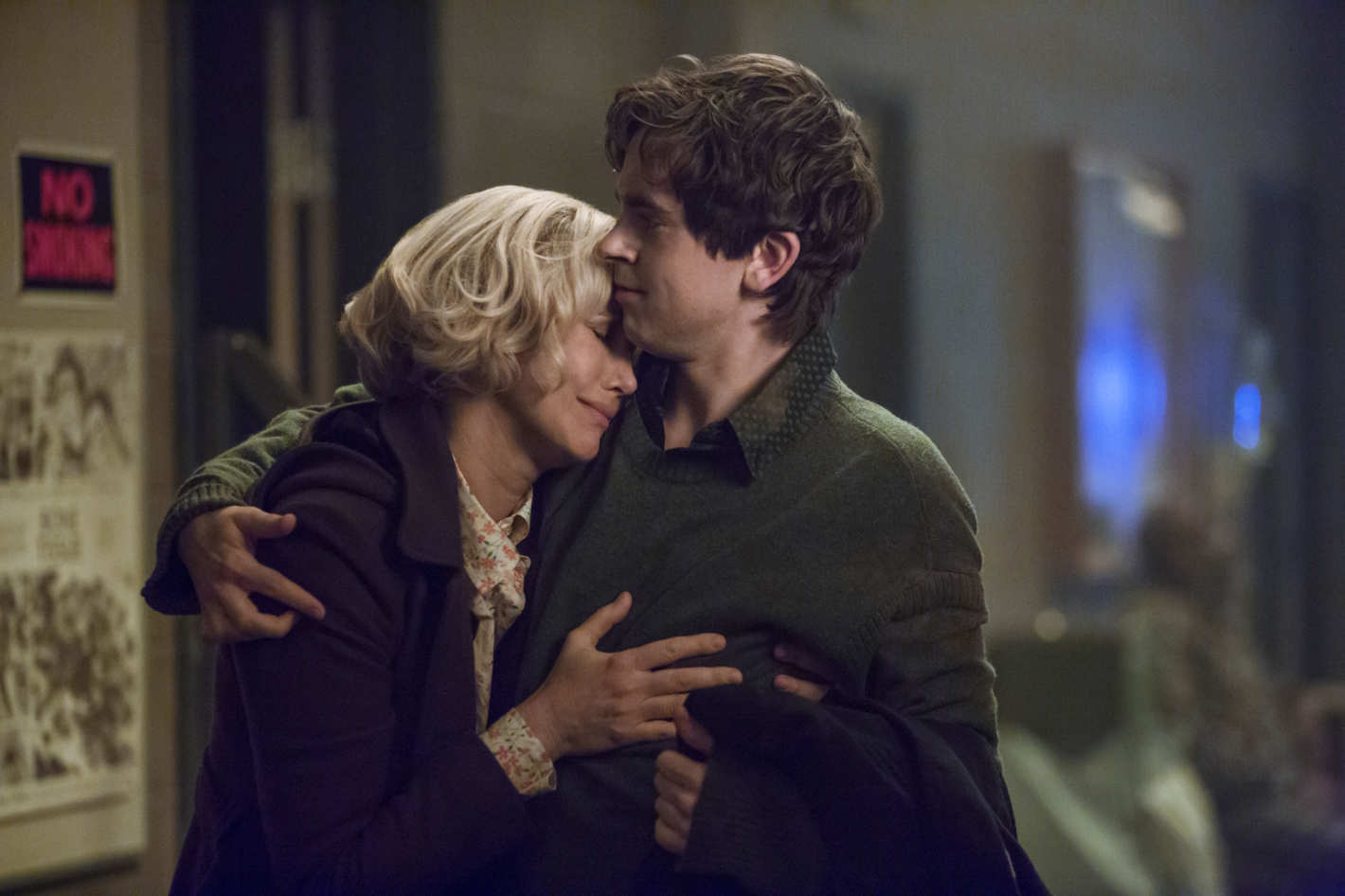
-The series, a contemporary prequel and reimagining of Alfred Hitchcock's 1960 film Psycho (based on Robert Bloch's novel of the same name). It depicts the lives of Norman Bates (Freddie Highmore) and his mother, Norma (Vera Farmiga) prior to the events portrayed in the film but in a modern-day setting. 
-In the television show, Bates motel, the main character - Norman bates. Both the 1959 novel, its 1960 film adaptation and the 1990 film prequel explain that Norman suffered severe emotional abuse as a child at the hands of his mother, Norma, who preached to him that sexual intercourse was sinful and that all women (except herself) were whores. The novel also suggests that their relationship may have been incestuous. After Norman's father, John Bates, died, as a result of Norman, his mother and himself live alone together.
-The show has an impressive 63 nominations for various awards and has successfully been awarded 3. These include Saturn Award, Chainsaw Award and a Gracie Allen award for best actress for Vera Farmiga.

MIGRAIN key concept research:

Norman Bates is a young man, suffering from dissociative identity disorder, who runs a small off-highway motel in Fairvale, California. As a child, Bates suffered severe emotional abuse at the hands of his mother. When Norma took in a lover, the teenage Norman killed them both with strychnine in a fit of jealousy and forged a suicide note to make it appear that the pair had killed themselves in a suicide pact. Norman inherited the motel and, after a brief hospitalisation for shock, he disintered his mother's corpse and used his taxidermy skills to preserve the body. With few visitors to the motel, Norman lives out a humdrum existence, sometimes holding two-way conversations with himself and his "mother" and occasionally lapsing into her personality whenever his sexual urges awaken. In Bates motel, he is constantly fighting between his multiple personas; he is both a charming, innocent boy, a possessive, temperamental boy and finally 'Norma'. Speculations of Norman having dissociative identity disorder, explain this. He 'becomes' his mother. All of this, overwhelmingly suggests he is mentally unstable. His representation is largely this; however, he is also seen as violent and impulsive. His physical portrayal is very smart, almost outdated. His mother, on the other hand, is presented as nuerotic. She is temperamental, fluctuating between being euphoric, dejected and enraged.

Norman Bates is being represented in a somewhat psychotic and multi faced way because it reflects on his personality disorder(s). His dual personality can be explained with the Freudian notion that all humans are bi-sexual and heterosexuality is shaped by our society. About Bates who was always confused with his sexual identity- half woman, half man – Hitchcock said that Bates’s feminine nature was the clue throughout the film.This brings to light the issues with the restrictive gender roles present at the time of the original media text. His mother is represented as such a frustrated, polarising character because it emphasises why Norman is the way he is. It is due to her influence hugely. This is evident from the fact that Norman's second persona is his mother. This includes dressing up like her, talking like her, visualising himself as her etc.

Norman's brother, Dylan, acts as a literary foil, demonstrating Norman's insanity with his calmer demeanour. He is much more socially competent in comparison to Norman despite being a child  conceived from incestuous acts forced upon his mother's brother. Over the course of the series, he has been shown to put the needs of others before his own. This is seen when he takes co-worker Ethan to hospital following his shooting by a tweaker and when he obtains the money needed for Emma's lung transplant surgery. He also cares a great deal about his younger half-brother Norman and can see he has serious mental issues.

To a large extent, yes, the representation is fair and accurate. Considering it was based on two original texts, there is a lot of evidence supporting that this is how the characters were meant to be represented. More generally, the character's all symbolise a variety of different notions or ideas fairly and accurately. Although there are stereotypes such as Norma's rapist being a misogynist, fat, white man or how Norman is presented as the stereotypical 'nerd', as he is bullied. These stereotypes are negative as they have a larger implication of viewers; it reinforces stereotypes that are not always true. 

Media Languages and Forms 

Denotation is the first level of analysis. What the audience can visually see on a page. Denotation often refers to something literal. In Bates Motel, we see a slightly dysfunctional family trying to make the best of the situation they are in. Connotations of this run much deeper. This links to Langer’s Theory of Symbols Langer asserts that symbolism underlies all human knowing and understanding “Symbols are … vehicles for the conception of objects.” One example of denotation are simply the character's names.


To continue on the names idea, Norman Bates’ name is equally evocative. “Norman” suggests the word “normal,” and the character does appear to be an average, harmless person on the surface. But, of course, he is anything but normal, as we learn when we witness his psychotic homicidal tendencies. The name Norman also sounds like nor man, with the suggestion that, while his sex is male, part of him is a reincarnation of his mother. So, in fact, he is neither woman “nor man,” but both in the same body. Similarly, Marion’s last name, Crane, is of course a type of bird. Norman Bates (Anthony Perkins), the proprietor of the motel where Marion stops in a rainstorm after stealing the money, reveals during supper in a parlor behind his office that he is an amateur taxidermist. He notes that he has a special interest in stuffing birds because they are passive creatures. 

In terms of costume, Norman is seen in typically very smart clothes. This adds to the conflicted view, viewers have of him. Everything about the character of Norman bates contradicts each other. Another type of clothing Norman wears is his mother's clothing. This develops the idea of Norman believing he 'is' her. For lighting, often in scenes where suspense is being built, lighting is more low-key. However, usually the lighting is often high-key. Mise-en-scene refers to everything in the scene. The main set is a replica of the original Bates Motel set from the film Psycho was built on location at approximately 1054 272nd Street in AldergroveBritish Columbia. For props, Norman likes to keep mementos of his victims such as his teachers necklace. Also, he is interested in taxidermy, adding to his already neurotic demeanour. In terms of setting, the main set is a replica of the original Bates Motel set from the film Psycho was built on location at approximately 1054 272nd Street in AldergroveBritish Columbia. This really connects the series to it's roots.


  • What work is being done by the sound track/commentary/language of the text?
  • What sound and visual techniques are used to convey meaning (e.g. camera positioning, editing; the ways that images and sounds are combined to convey meaning)?

This entire scene uses continuity editing and is in a linear narrative to ensure the smooth transition of time to avoid disorientation of the audience as the events are already quite hard to follow. To begin, the lighting is blue toned throughout this clip which is a conventional colour used in the horror genre. The use of mood lighting here is perhaps to achieve a practical or aesthetic effect but more likely to create an ominous, eerie and menacing atmosphere. This effect is successful at the mood the director intends to create, as the colour blue typically holds connotations of sadness. Also, in Iran, blue is symbolic of mourning which is especially relevant and is foreshadowing of the events that will follow. To continue with the use of lighting, it is mainly low-key lighting but there are still many shadows which add to the ambiguity of the actions that will occur. This creates enigma.

In terms of camera shots, this scene begins with a medium shot of the two main characters of the show; Norma and Norman who is watching over her. The camera then pans to Norman walking away from the bed. Immediately, the audience feel fearful of what his next actions will be. This is achieved by his unpromising demeanour and facial expression. Here, we can say this entire scene so far is an enigma codeas we are unsure of what Norman will do or what will follow. Moreover, the lack of sound and over emphasis on the creaking, breathing and other generic, small, diegetic noises reinforces the genre of horror whilst adding tension. This, therefore helps the audience to anticipate with apprehension or fear.

The next shot, following immediately from Norman leaving the bedroom, is to the stairs of the basement. The jump cut here is very abrupt which makes it effective as the audience’s attention is forced to focus on Norman so they are aware that something is going to happen. This is also an example of enigma code. The shot of Norman is an establishing shot and a long shot. This enables the audience to see the basement which gives the impression of something bad happening as well as being a fairly disconcerting setting and conventional of horror. What is most interesting about this specific shot is that it is taken at a low angle. This gives the subject of the shot an impression of dominance. This is significant as we, as the audience are given a reminder of the power he holds. This is because earlier in the show we are aware of the fact that the boiler in the basement, if turned on before being fixed, could release fatal fumes. This is an example of foreshadowing and although some viewers may not realise this, the entire show uses intertextuality. The basement is almost identical to the one in ‘Psycho,’ which not only gives the audience the pleasure of recognition but also forces the audience to realise the reality of what will inevitably happen. This scene highlights on this as the tense mood suggests the build up to this reality is perhaps soon to come. Norman walks down the stairs, towards the camera and then the camera moves to behind the shelf of lethal chemicals and faces Norman walking closer to the boiler. This is an example of an action code. During this part of the sequence, slow, sorrowful music begins to build up. This is another action code as the audience are likely to believe something tragic will happen.

As Norman tears the caution tape off the boiler, opens and lights it, the light music becomes louder and more eerie. The camera zooms in slowly until it is directly in front of the fire and Norman’s face. This shot is a medium close up. This may have been intentionally used to focus on the character’s expression as he is quite neutral which adds to the disturbing nature of his actions. The camera tilts upwards into the boiler and a tracking shot is used. Here the pace increases significantly. The camera follows through a pipe and follows Norman as we can see the vents being closed through the pipe. The camera shots rotate between being in the pipe and to the house where we can see Norman closing the vents. This gives the audience a slightly disorientated effect. The music here is a especially interesting in the editing of this scene as it is an example of contrapuntal sound.

The use of contrapuntal sound is generally used to evoke a reaction of shock or to emphasise the feeling of disgust or horror towards what is happening. Here, we could also argue that the use of contrapuntal sound highlights how disturbed and conflicted Norman Bates’ mind is as he is in a state of out-of-body experience. The song used here, ‘Mr Sandman,’ is very obviously a deliberate choice as it is a traditional pop song which heavily juxtaposes with the sinister actions we can see. However, the context of the song could link to the ideas or intentions the director perhaps had. Mr. Sandman was the mythological creature who threw "sand" on people to put them to sleep to give them good dreams. In Norman’s warped state of mind, it may have been likely that he felt he was doing good by putting his mother in a ‘dream’ forever. Whilst this music is playing more close up’s of Norman are shown and what strikes me as interesting is the use of the shutters of the vents shutting and covering his face. This is an example of a fade out is very clever as it serves the idea of him trying to hide and shows the demented aspect of his personality. Eventually his dark ‘side’ will overtake everything which correlates to the actions he is about to commit. Finally, he returns back to the bedroom where Norma is sleeping, lays down with her and leaves the vent open in their room.

The pace decreases again. The camera work that follows, is notably picturesque and striking. The camera slowly pans around the rest of the house. The audience are given very delicate but eerie shots of the rest of the house until we enter the basement and return back to the boiler where we see an extreme close up of the fire. The scene ends with this shot suggesting the fate that will come next is menacing. This along with the contrapuntal music leaves the scene ending on a very sinister tone and is an example of a cliffhanger.

  • What are the dominant images and iconography, and what is their relevance to the major themes of the text?
A lot of iconography has to do with the mise-en-scene. The physical attributions in a scene of a film in general give a lot of obvious indications to the audience and helps construct the plot line and elevates the feelings that were meant to make the audience feel a certain way when watching horror. Shadows give psychological thrillers the 'on edge' tense feeling by using something with such anonymity. It is commonly associated with thriller as they generally build up the fear in the audience. In many cases in thriller films the protagonist is actually unaware of said on-comer as a shadow seems to be something that passes by unnoticed. The character may be about to encounter a situation that is quite dangerous that they aren't aware of but you are, which is the use of dramatic irony. A confined space is definitely a icon in the genre of horror. Horror films make the audience nervous and a way to do this is to play on the audiences fears. Many people having some issues with small spaces, some even claustrophobic, so to use this as a way to terrorise the audience is particularly effective. Another iconic thing that is used in Bates Motel is running water. Running water can represent the draining of life and can keep the audience on edge as to use something as ordinary as running water and to put it into an environment where it is
made sinister, it breaks the boundary of comfort for the audience. 

Street lamps are an effective part of mise-en-scene and are effectively used in thriller films particularly in relation to the protagonist. This is because the light directly on the character, acting almost as a spotlight, and the surrounding being mainly the darkness. This can be iconic as the surrounding dark can represent the struggles of the protagonist. Furthermore, the fact that there is plainly a spotlight on the protagonist could show isolation which is particularly effective the audience as it could engage them too, making them also feel alone as there isn't much else more to focus on on screen to act as a safety barrier.  Having the blockade of freedom for a character creates the sense of imprisonment and entrapment, not just for the character but for the audience also. The audience becomes so engaged with the character in regards to sympathy that they start to empathise with the character and then begin to feel what they feel. Feeling as though you are going through the same experience as the character as an audience member, especially in a horror, is particularly effective as the tense atmosphere created goes hand-in-hand with the genre by playing on the fear of being isolated.

Narrative 

The show is set before 'Psycho', it's a prequel to it. We would assume that obviously the show would be set before 1960, however, it is set in modern day. This means the show has adapted to modern values and ideologies yet still tried to retain the older ones. Speaking more technically, the media text is a television series. It is structured into episodes and seasons - this means viewers having gaps between series/seasons. Also, it means there can be a lot more depth and longevity in the fan-base of the show. 

The audience, who are likely fans of Hitchcock's 'Psycho', are positioned very differently to how they were when watching psycho. This is mainly due to how it is set in an entirely different time period - modern day. Also, the fact that the media text is a series, means there are huge cliffhangers and gaps between each episode or season. This entices viewers further, encouraging them to continue with the show.

All the characters in the show embody the role of villains or heroes during different parts of the shows. For example, although most people would recognise Norman as the key antagonist but during certain parts of the show, he is the polar opposite at times. One moment that demonstrates this is when he drops everything to save his mum from being raped or when he takes care of Emma.

In terms of identification, almost all viewers can identify with some of the characters to some extent. Their respective traits are likely to resonate in viewers because they have very complex mentalities. For example, although we may not all be serial killers (hopefully), we may see the impulsive behaviours apparent in Norman, in ourselves.

  • What are the major themes of the narrative? What values/ideologies does it embody?

Criminality

There are two criminals in Psycho: Marion Crane, who steals a large sum of money, and Norman Bates, who's a mass murderer. Obviously, these aren't equal crimes. Norman Bates is a sicko, and Marion made a really bad decision. Yet, Marion and Norman are still linked—not least in the fact that Norman ends up killing Marion, which functions as an ironic final punishment for her crimes. They both "go a little mad sometimes," which connects them. They may be on opposite ends of the criminality spectrum, but they're still on the spectrum.


Family

Related imageIn Psycho, family means mother. And it also means Freud. Sigmund Freud believed that little boys have a sexual attraction to their mothers, and therefore resent their fathers—the famous Oedipus Complex. Eventually, the son is supposed to outgrow the love for the mother and transfer his affections to other women. But Norman loved his clinging mom too much, killed her in a jealous rage at her new boyfriend, and now whenever he tries to change his affections, he ends up killing the woman in question. Mommy issues: they'll mess you up every time.
Madness

Sex
Sex scares Norman;whenever he thinks about sex, he feels so guilty he attempts to harm someone. Sex does the same to Marion, too; in order to stop having illicit sex, she steals a huge amount of money and goes on the run. Sex in Psycho doesn't make pleasure and babies; it makes madness and corpses beneath the swamp.

Madness
Madness in Psycho is mainly about gender confusion. Norman is conflicted. His sexual desire, his mother love, and his jealousy have all gotten tangled up together so he doesn't know whether he's a mama's boy or a murdering mother. Norman doesn't fit into his gendered role as a regular guy, and so he must be a murderous lunatic. In reality, of course, transsexual women or transvestites aren't any more likely to be insane or dangerous than anyone else. In presenting cross-dressers as murderers, Psycho is revealing its own prejudices and irrational fears—its own madnesses, in other words.

Genre                                                         
The camera angles connote the fear in the movie by doing many natural lighting shots. The director will use many close angles, low and high angle shots and point of view shots. This makes you feel part of the movie and the suspense is anxiously waiting. This is normally used to keep the audience members engaged with the storyline. Music and sound effects play a big part in making a movie a success. Lots of incidental music is added and Foley sound effects can be used to make the intenseness more striking for the target audience. When a particular sound of music which is usually been made for that specific movie or show it is known as theme music. This makes the audience recognised what product they are watching. The audience is made to view scenes of gaze for the heterosexual male. Sex and male gaze is portrayed commonly in horrors. Nudity has been accepted on screens to pleasure the male gender. It is not in usually to see woman naked in a movie of this type. Usually when a young woman appears naked in a scene it is time for her to be terribly killed by the pray/ murder. The murder will probably stab or suffocate her. Although not entirely nude, when Norman Bates teacher is dressed provocatively, he coincidentally murders her. Finally, common binary opposite in horror films is good vs evil. Settings of where the evil resides in bates motel includes  dark, empty places such as Norman Bates Basement
.


Themes include: 
- criminal vs police
In the first season where Norma battles with the police, trying to cover up her crimes.
- power vs vulnerability
Norma is often a victim of those more powerful than her such as men, the police, the government etc.
- justice vs injustice 
Often there is an innocent and guilty party whether it be Norma and the police or   Romero against Norman etc. 
- male vs female
This is seen frequently in the show; Most likely this is the biggest theme within the show This theme embodies the patriarchal society.


Related imageThe show is a hybrid; It is mainly a Mystery, Psychological Horror/Horror and Drama. Some generic conventions that are strongly associated with these kinds of genres include how there is always a ‘hero’ or protagonist, a man or a ‘final girl’ of the film, keeping with the normal conventions of the genre. Usually the hero must embark on a mission or quest to kill or solve problems in order to save themselves or others around them.This trope is very clear in Bates Motel. Some directors use the innocence of children to be the villain of the movie. Using a small child who does scary and supernatural activities makes the story line more freaky and disturbing for the viewers. Audience members are totally surprised when the child who may look like the victim turns out to be the villain. As we associate children with happiness, playful and innocent the thought of a child doing adult like behaviour becomes creepy.  For example The Exorcist is a film about a young girl who is possessed by the devil. William Friedikin the director used Religion in an unseen way; this film was eventually banned as people thought it was too explicit and outrageous. There have been many remakes of the Exorcist and it has still had the same reaction. In Bates Motel, they intentionally made use of Norman Bates as a young teen to evoke this same reaction in audiences.

Iconography is a symbolic representation. It is used within media texts to describe the visual language of a film, particularly within specific genre. We expect to see certain objects on screen when we see a particular genre, these are called ‘genre indicators'.  Horror texts have a specific pattern which allows the audience to identify the genre. Iconography of horror movies can be the symbolic symbols that are shown throughout the movie, for example in Bates Motel, the old house, disguises, or death symbols such as blood, knife, bodies etc.  Moreover, often dark colours like red and black are used as they commonly link to evil, blood and danger etc. 

  • To what extent are the characters generically determined?
Considering that the characters are based off two original texts (the book and film : Psycho), the characters are fairly determined. However, the show has been extremely innovative in that they have created extended family, deeper traits, connections etc. Also, the fact that has been modernised changes the characters traits hugely.

  • Does the text feature a star, a director, a writer etc who is strongly associated with the genre? What meanings and associations do they have?
The show features some hugely successful actors. Most notably, Marion is played by singer, song-writer 'Rihanna'. Some reoccurring characters include Freddie Highmore, Vera Farmiga, Max Thieriot, Olivia Cooke and Nestor Carbonell.  All of these actors all already have established fanbases of a notable size. In particular, Vera Farmiga is strongly associated with the horror genre due to her role in the two Conjuring films, as well as 'Orphan'.

Narrative Theory:

Propp was essentially interested in the narrative of folk tales. He noticed that often many Folk tales were similar in a variety areas. He identified a theory about characters and actions as narrative functions. Hero - Traditionally the hero is a male protagonist whose role it is to restore normality or equilibrium. He does this by defeating the villain(s) and winning the love of the heroine. Villain - The villain is the cause of the disruption and the enemy of the hero. The villain may also be a threat to the safety and the well being of the heroine. Dispatcher - The dispatcher sends the hero on a journey to restore equilibrium. The dispatcher may also be the father or a father figure of the heroine, sending the hero on a quest to see if he is worthy of his daughter. Donor - The donor gives the hero something to help him along his journey. This gift may be a piece of advice, a skill or an object such as a weapon. Helper - The helper assists the hero in restoring equilibrium. The helper may be a sidekick, with the hero throughout, or someone he meets along the way. The Princess -  The character who needs to be rescued from the evil villainFalse Hero - The false hero is a character who initially seems to be on the side of the hero but who turns against him or deceives. To apply this to Bates Motel, the hero is most likely to be Romero, the villain is Norman or Shelby (Norman more of an antihero). The dispatcher would likely be someone like Dylan or Romero, the donor may be someone like Chick, the false hero, Norman, the princess, Norma. 

Todorov suggested that conventional narratives are structured in five stages. This type of narrative structure is very familiar to us and can be applied to many ‘mainstream’ film narratives.
  • a state of equilibrium at the outset; 
  • a disruption of the equilibrium by some action; 
  • a recognition that there has been a disruption; 
  • an attempt to repair the disruption; 
  • a reinstatement of equilibrium or a new equilibrium created. 

This narrative structure is only to some extent apparent in Bates Motel. Some minor storylines in the show follow this structure well, yet the general plot, strays from this.

Media Institutions 

  • What is the institutional source of the text? 
It is produced by American genre. Also, It is produced by universal television. It is the television production subsidiary of the NBCUniversal Television Group and, by extension, the production arm of the NBC television network (since a majority of the company's shows air on NBC, and accounts for most of that network's prime time programming).
  • In what ways has the text been influenced or shaped by the institution which produced it? 
American Genre are the producers; this is relevant as the show includes some American values/ideologies. For example hedonistic behaviour, weaponry, american dream notion etc.
This show is an example of commercial institution. this makes the show designed for people who need a form of entertainment rather than surveillance. 
A&E Networks and NBCUniversal Television Distribution are responsible for the distribution of the show. 


Media Values and Ideology  

  • What are the major values, ideologies and assumptions underpinning the text or naturalised within it?
Firstly, we have established that the show portrays men as malicious most of the time. This is perhaps done to reflect the patriarchy apparent in society.
  • What criteria have been used for selecting the content presented?
The show is rated at 18, this is due to the gore and raw content. Also, in America, it broadcasts post watershed.
  • How does the text fit into the current political landscape?
The show brings to light the inferior status women have in comparison to men - this relate to today with the gender inequality issues we currently face.
  • Does the text promote a particular political viewpoint - either explicitly or implicitly? 
Hitchcock was never a political man. In fact, as one astute author pointed out, out of the hundreds of interviews he gave, he wasn’t ever caught giving an explicit political statement of any kind. Considering Bates Motel is based on the original text sourced by him, this suggests the series adopts an apolitical stance. However, Bates Motel has shown to be leaning towards a left wing outlook. For example, how Norman bates was dressed as himself - rather than as his mother - when he goes to strike his helpless victim. Show writers explained their fear the scene could otherwise be construed as 'transphobic'.


http://www.dailymail.co.uk/news/article-4415278/Psycho-remake-won-t-cross-dressing-scene.html

Media Audiences  

Bates motel is targeted predominantly at teenagers. This is apparent from the modern take on characters and setting. For example, it based on a teenager and some examples of setting include a high school. Also, the fact that it airs at 9pm, makes it easy for teens to watch. The secondary audience may be slightly older; they are likely to be watching because they are fans of 'Psycho', the original. We can assume that viewers are aware of Hitchcock's original work 'Psycho'. Also, we can assume they like suspense, drama and thriller.

It airs at 9pm, suggesting young adults are most likely to watch the television show. It is broadcasted on A&E Network, an American television show, suggesting a majority of viewers are indeed American. However, the show is also available more universally on streaming services including Netflix, google play, YouTube red, Prime etc.

From these charts, we can see each episode has a high viewer count. An average would be a 2.1m viewer count per episode. However, as we can see the viewer count has declined gradually. Perhaps this is due to the hype of the show dying down gradually.
According to Blumer and Katz there are four man uses or gratifications. Firstly, diversion, this refers to the idea of using social media as a form of escapism. People use bates motel to escape from their own mundane lives; they delve into the storyline of the show. Next, there is personal identity. This refers to identifying with a character you see on screen. Whilst most viewers are unlikely to be murderers or drug dealers, they may still see certain traits in the character's they see that they relate to. Personal relationships refers to when viewers form a bond with the characters they see; they become emotionally invested in their lives. 


Critics


Interviews